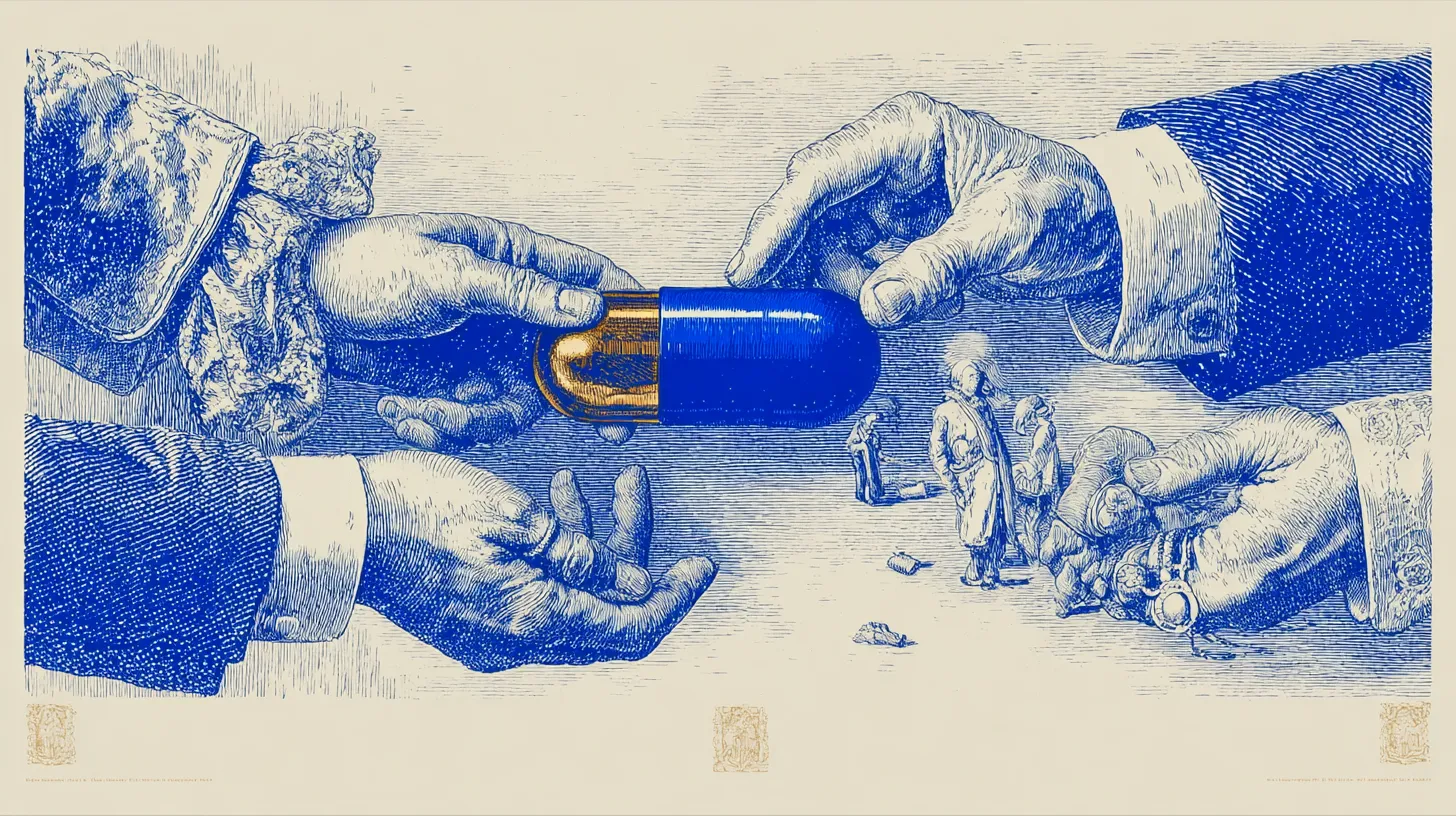
Here is a number worth holding in your head: $356 billion.
That is the estimated gap, in 2024, between what brand-name drugs cost at list price and what drug manufacturers actually received after all the discounts, rebates, and fees got clawed back out of the channel.[1] Three hundred fifty-six billion dollars — an amount roughly equal to the entire GDP of Denmark — evaporated somewhere between the factory and your pharmacy counter.
Where did it go?
The answer to that question is, more or less, the entire story of American drug pricing. It is a story the people who benefit most from the current arrangement have a powerful financial incentive to keep opaque. But the numbers are in the public record if you know where to look — in SEC filings, HHS analyses, and the annual Economic Report on U.S. Pharmacies and Pharmacy Benefit Managers from the Drug Channels Institute, which functions as the closest thing this industry has to an impartial ledger. Let’s open it.
A Simple Transaction That Isn’t
Start with the basics. Your doctor writes you a prescription. You take it to the pharmacy. The pharmacist fills it. You pay your copay and leave. Simple.
Except: your insurance plan has a contract with a Pharmacy Benefit Manager (PBM) that determines which drugs are covered and at what tier. The PBM has a contract with the drug manufacturer that determines what rebate the manufacturer pays back in exchange for formulary placement. The PBM has a separate contract with your pharmacy that determines how much the pharmacy gets reimbursed — often set in ways the pharmacist cannot fully predict at the time of dispensing.[2] Your copay is calculated from the drug’s list price, not its net price, so you may be paying a percentage of a number that no one in the transaction actually charges anyone else.
Every single one of those contracts is confidential.
Five parties touched your prescription. One of them — you — has no negotiating power, no visibility into the pricing mechanics, and no way to know whether the amount you paid bore any relationship to what the drug actually cost anyone in the chain.
The Margin Scoreboard
The U.S. Department of Health and Human Services, through its Office of the Assistant Secretary for Planning and Evaluation (ASPE), published a landmark analysis of drug supply chain intermediary margins in 2024 — probably the cleanest independent accounting of who takes what that currently exists.[3]
The findings, for 2022:
- PBMs: $60.6 billion in gross margin — a 31.2% margin on the drugs flowing through their systems
- Wholesalers — the companies that physically warehouse and distribute drugs — captured $23.4 billion, a margin of 6.3%
- Retail pharmacies captured $12.2 billion, a margin of 3.2%
Read that again. The entity that physically makes the drug available to you — the pharmacist who checks for interactions, counsels you on dosing, and is often the most accessible healthcare professional in your community — captures a 3.2% margin. The middleman who processes the claim and manages the formulary captures 31.2%.
This is not a feature of some ruthless but efficient market. It is the fingerprint of a captured one.
What the Conglomerates Actually Report
PBMs don’t exist as standalone entities anymore. The three largest — CVS Caremark, Express Scripts (owned by Evernorth/Cigna), and OptumRx (owned by UnitedHealth Group) — are embedded inside vertically integrated conglomerates that also own the largest health insurers and the largest specialty pharmacy networks. This matters because it means profits can be moved between business lines, and the full picture of PBM profitability is deliberately difficult to reconstruct from public filings.
Still, what they do report is instructive.
CVS Health’s health services segment, anchored by its Caremark PBM, generated $7.2 billion in adjusted operating income in 2024.[4] Evernorth, Cigna’s pharmacy services arm, is projected to deliver at least $7.2 billion in adjusted income from operations in 2025, with pharmacy benefit services alone generating $111.8 billion in adjusted revenue in 2024 — a 46% jump from the year prior.[5] OptumRx, UnitedHealth Group’s PBM, reported full-year 2024 revenues of $34.2 billion with a segment operating margin of approximately 4.4%, implying roughly $1.5 billion in operating income — an estimate derived by applying the company’s reported Optum Rx operating margin to its reported revenue.[6]
Three PBMs. Combined adjusted operating income in the range of $15–16 billion annually, flowing from a business whose stated purpose is to lower drug costs on behalf of the plan sponsors — employers and insurers — who hire them.
Where the $356 Billion Went
Back to that number.
The gross-to-net bubble — the gap between list price and what manufacturers net after all rebates and discounts — reached $356 billion in 2024.[1] More than half of that total flows to PBMs and third-party payers in the form of rebates and fees manufacturers pay for formulary positioning. Most of it eventually gets passed through to plan sponsors. But the word “most” is doing enormous work in that sentence.
The portion that doesn’t get passed through is PBM profit. And crucially: because these contracts are confidential and the accounting is deliberately structured to be opaque, neither plan sponsors nor patients have any reliable way to know how much was retained.
What we do know: drugs with higher rebates get better formulary placement. That means the drug your plan covers at the lowest copay tier is not necessarily the most effective drug, or the cheapest drug — it is the drug that generated the most rebate revenue for the PBM. Your formulary is, in part, a revenue maximization tool dressed up as clinical management.
The Pharmacy Side: Squeezed to the Wall
While PBMs compound their advantage, the pharmacies at the end of the chain are being systematically compressed. Independent pharmacy gross profit margins hit a 10-year low of 19.7% in 2023 — that’s gross margin, before rent, payroll, and overhead.[7] In many cases, PBM reimbursement rates for specific drugs fall below what the pharmacy paid to acquire them. The result: independent pharmacies closed at a rate of more than one per day in the twelve months ending mid-2024.[7] Each closure is typically a rural or low-income community losing its most accessible point of healthcare contact.
Meanwhile, PBM-owned specialty pharmacies captured roughly two-thirds of specialty drug prescription revenues in 2024[9] — set by the same entities writing the reimbursement rules for everyone else. The referee owns the winning team. There’s much more to this story, and we’ll tell it.
The Employer (Your Boss) Isn’t Winning Either
You might assume that employers — who purchase commercial pharmacy benefits on behalf of their workforces — are the savvy buyers keeping PBMs honest. They are not.
Survey data from the Pharmaceutical Strategies Group found that only about 60% of employers report their PBM passes through all rebates, and one-third are on spread pricing contracts — arrangements where the PBM charges the health plan more than it pays the pharmacy and keeps the difference, invisibly.[10] Hard commercial data on the dollar magnitude of spread pricing is scarce, not because it doesn’t happen, but because the confidentiality provisions in PBM contracts are themselves a feature of the system. When state governments have obtained auditing authority, documented spread pricing has consistently exceeded what PBMs disclosed.[12] Commercial employers have fewer protections and less leverage. The data gap is not an oversight. It is an architectural feature — and we’ll explore it in depth separately.
A System Designed to Obscure Its Designers
The architecture of American prescription drug pricing was not designed. It accreted — contract by contract, merger by merger, regulatory carve-out by regulatory carve-out — over thirty years of consolidation. But its current form serves the interests of the entities that grew largest inside it.
The PBM industry argues that it saves money — their trade lobby, PCMA, claims PBMs generate approximately $1,154 in annual savings per member. This figure is contested. The U.S. pays nearly three times what comparable countries pay for the same drugs. If the middlemen are saving money, the question worth asking is: compared to what alternative, and who is keeping the savings?
The ASPE analysis provides the cleanest available answer. Pharmacies: 3.2% margin. Wholesalers: 6.3% margin. PBMs: 31.2% margin.[3]
The entities adding the least clinical value to your prescription drug experience are extracting the most financial value from it.
That is not an accident. It is the point.
Sources
- Drug Channels Institute. “Gross-to-Net Bubble Hits $356B in 2024.” July 2025. https://www.drugchannels.net/2025/07/gross-to-net-bubble-hits-356b-in.html
- International Foundation of Employee Benefit Plans. “Prescription Drug Plans: Spread Pricing Explainer.” March 2024. https://blog.ifebp.org/prescription-drug-plans-spread-pricing-explainer/
- U.S. Department of Health and Human Services, ASPE. “Pharmaceutical Supply Chain Intermediary Margins in the U.S. Retail Channel.” September 2024. https://aspe.hhs.gov/reports/margins-retail-channel
- Healthcare Dive. “CVS slashes profit in 2024 as high medical costs hit Aetna.” February 2025. https://www.healthcaredive.com/news/cvs-q4-2024-earnings-medical-costs-profit-slashed/739959/
- Managed Healthcare Executive. “Cigna’s 27% Revenue Increase in 2024 and the Outlook on 2025.” March 2025. https://www.managedhealthcareexecutive.com/view/cigna-s-27-revenue-increase-in-2024-and-the-outlook-on-2025
- UnitedHealth Group SEC 10-Q Filing (Q1 2024), reporting Optum Rx segment operating margin of approximately 4.4% and full-year 2024 revenue of $34.2 billion. https://www.sec.gov/Archives/edgar/data/0000731766/000073176624000155/unh-20240331.htm; revenue figure from Fierce Healthcare: https://www.fiercehealthcare.com/payers/unitedhealth-group-posts-144b-profit-4003b-revenue-2024
- National Community Pharmacists Association. “NCPA 2024 Digest.” October 2024. https://ncpa.org/newsroom/news-releases/2024/10/27/ncpa-releases-2024-digest-report
- Centers for Medicare & Medicaid Services. Medicare Part D Final Rule CMS-4192-F (May 2022), cited in: Epstein Becker Green. “CMS Finalizes Changes to Pharmacy DIR in Part D Starting with Contract Year 2024.” https://www.ebglaw.com/insights/publications/cms-finalizes-changes-to-pharmacy-dir-in-part-d-starting-with-contract-year-2024
- Drug Channels Institute. “The Top 15 Specialty Pharmacies of 2024.” June 2025. https://www.drugchannels.net/2025/06/the-top-15-specialty-pharmacies-of-2024.html
- Drug Channels / Pharmaceutical Strategies Group. “Surprising Data on Employer-PBM Rebate Pass-Through Arrangements in 2023.” August 2023. https://www.drugchannels.net/2023/08/surprising-data-on-employer-pbm-rebate.html
- International Foundation of Employee Benefit Plans. “Prescription Drug Plans: Spread Pricing Explainer.” March 2024. https://blog.ifebp.org/prescription-drug-plans-spread-pricing-explainer/
- State Medicaid spread pricing audits: Ohio, West Virginia, Kentucky. See also: GAO. “Prescription Drugs: Selected States’ Regulation of Pharmacy Benefit Managers.” November 2023. https://www.gao.gov/assets/d24106898.pdf
- U.S. Department of Labor / Federal Register. “Improving Transparency Into Pharmacy Benefit Manager Fee Disclosure.” January 30, 2026. https://www.federalregister.gov/documents/2026/01/30/2026-01907/improving-transparency-into-pharmacy-benefit-manager-fee-disclosure